
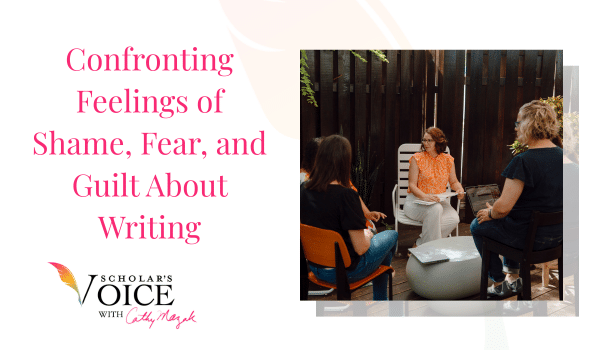
Confronting Feelings Of Shame, Fear, And Guilt About Writing
Guilt, shame, and fear around academic writing show up far more often than we admit. And for many academics, those emotions become so intertwined with our identity that even seeing the phrase “making time to write” can trigger a full-body “Nope!”
MORE DETAILS
I was reminded of this last week during the National Women’s Studies Association conference in Puerto Rico. The conference was beautifully integrated with local scholars, activists, and artists, creating a powerful space for community and reflection.
What surprised me most, though, was the range of reactions people had when they walked by our booth and saw my book. Some people laughed; some avoided eye contact and literally walked (or ran!) away; others said, “You’re making me feel so bad.”
That emotional recoil is exactly why today’s episode exists.
This week, I’m diving deep into what guilt, shame, and overwhelm around writing really reveal—not about you as an individual, but about the sociocultural and institutional contexts you’re working within. If you’ve internalized the idea that your inconsistent writing practice is a personal flaw, this discussion will help you understand why that narrative is wrong, and how to reclaim the sense of agency you absolutely do have.
If you’ve ever thought, “I should be writing,” and immediately felt terrible, this one’s for you. Tune in, and let’s talk about what’s really holding back your academic writing and how to move through it.
Why We Feel Guilt, Shame, and Avoidance Around Writing
During the conference, I was reminded that many academics interpret a lack of writing as a personal failure. Shame often comes from believing I’m the problem. Guilt shows up when we think we’re letting others down, collaborators, colleagues, students. Overwhelm comes from the constant sense that no amount of work will ever be “enough.”
But these feelings rarely originate inside us. They’re shaped by institutional expectations, gendered service burdens, racialized dynamics, advising loads, student demands, and the invisible labor placed disproportionately on women and non-binary faculty.
When you’re living inside an academic structure designed to consume time and reward overwork, emotional fallout is predictable, not personal. Naming the feeling is the first step. Understanding its roots is the second. Only then can you start letting go of the belief that writing problems are character flaws.
The Context You’re Working In (Not Your Personality) Creates Writing Barriers
If you’re a woman or non-binary scholar, you’re almost certainly carrying more service, mentoring, and emotional labor than your colleagues who hold more privileged identities. Success only compounds the demand: the better advisor you are, the more students seek you out. The more impactful your research, the more collaborators want you involved. These are “good problems,” but they’re still problems, and they absorb time that could be dedicated to your academic writing and publications.
Add to that the backlash women and non-binary scholars receive for setting boundaries that men often implement without consequences. A man who says, “I’m not on campus that day” is seen as firm. A woman who says the same is often labeled difficult or selfish. These structural double standards shape your workdays, workloads, and emotions. When you feel guilty for not writing, you’re reacting to conditions designed to make writing difficult, not to a personal inadequacy. Recognizing context is liberating: it’s not about giving up, but about reclaiming your narrative and acting with agency.
Reclaiming Agency Through Reflection and Narrative Shifts
You can feel guilt, shame, or overwhelm and still move forward. The key is understanding what those emotions are trying to tell you. I offer three reflection questions that help you reconnect with your sense of agency:
- What exactly am I feeling—guilt, shame, overwhelm, frustration, fear? Name it clearly.
- How is my academic context contributing to that feeling? Think about your department, collaborators, advising load, identity dynamics, and institutional culture.
- What story am I telling myself that reinforces this feeling? Is it “I’m the problem”? “I’m letting everyone down”? “I should be able to handle more”? These stories shape behavior far more than we realize.
Once you unpack the feeling, context, and narrative, change becomes possible. You can adjust boundaries, rethink commitments, and redesign your writing life from a place of clarity, not punishment. Agency isn’t about dismissing the oppressive systems around us; it’s about finding the space within them to build the academic life you deserve.
“We are all experiencing racism, sexism, and ableism – all horrible things that are actual characteristics of not only the society in which we live, but of our institutions. They are ingrained, institutionalized. Yes, we are experiencing that and yes, we also have agency to act on our own behalf within those contexts. It doesn’t make the racism go away, it doesn’t make the sexism go away, but it gives us a starting point to enter with agency and make the careers that we really deserve to have and that we really know that we can have.”
“I believe that even people in horribly oppressed and terrible departments still have some agency to make their situation better. It often has to do with internal work, your mindset around something. It’s the way that you’re thinking about it. It’s the story that you’re telling yourself. What I want for everyone is for them to work through those feelings of guilt and shame and overwhelm. Because on the other side there is so much agency and power. That’s what I really want for all of you.”
We’re receiving applications for our next cohort of Navigate: Your Writing Roadmap®. Check out the program details and start your application process here.
CONTINUE THE CONVERSATION:
- Our 12-week Navigate: Your Writing Roadmap® program helps tenure-track womxn and nonbinary professors to publish their backlog of papers so that their voice can have the impact they know is possible. Apply here!
- Cathy’s book, Making Time to Write: How to Resist the Patriarchy and Take Control of Your Academic Career Through Writing is available in print! Learn how to build your career around your writing practice while shattering the myths of writing every day, accountability, and motivation, doing mindset work that’s going to reshape your writing,and changing academic culture one womxn and nonbinary professor at a time. Get your print copy today or order it for a friend here!
- If you would like to hear more from Cathy for free, please subscribe to the weekly newsletter, In the Pipeline, at scholarsvoice.org. It’s a newsletter that she personally writes that goes out once a week with writing and publication tips, strategies, inspiration, book reviews and more.
CONNECT WITH ME:
RELATED PODCASTS

Stay current in Academic Publishing
Subscribe to our newsletter:
In the Pipeline
writing tips, publishing trends, reading recomendations, free workshops