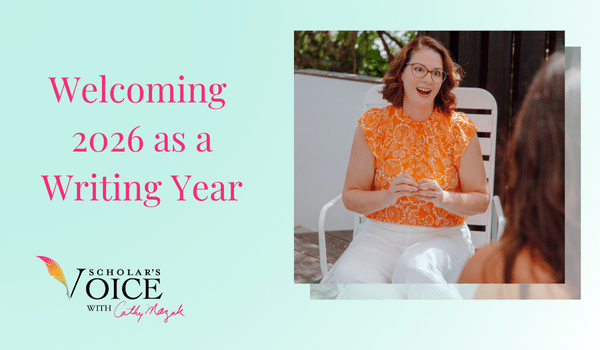
Welcoming 2026 as a Writing Year
What if 2026 wasn’t the year you tried to do everything, but the year you finally did the thing that most aligns with your academic mission statement?
MORE DETAILS
In this episode, I’m officially inviting you to make 2026 your writing year. I’ve been planting this seed for a while now, especially as we collectively move through ongoing funding uncertainty and career volatility. Today, I want to slow down and really explain what I mean by a “writing year,” why so many scholars are choosing this path right now, and how you can begin making this shift in a practical and sustainable way.
I walk you through what a writing year looks like, how it can become a powerful decision-making framework, and how I’ll be supporting scholars throughout 2026 with free workshops, coaching series, and a newly redesigned podcast format. I also share details about my Navigate program.
If you’re ready to lead your academic career with intention and make real progress on the academic papers that matter most, this episode is your starting point
What a “Writing Year” Really Means
A writing year is not a year where you stop teaching, stop doing committee work, or stop applying for grants. It’s a year where writing and publishing become the primary focus, and everything else is adjusted accordingly.
This idea comes from my broader framework of seasonality, the understanding that academic careers move in phases. There are seasons when grant writing must take priority, seasons when teaching is the central focus, and seasons when service responsibilities are heavier. A writing year is simply a season where the volume is turned up the highest on writing and publishing.
Trying to excel at teaching, service, grants, mentoring, and publishing all at once is not sustainable. We don’t have 400% effort to give. A writing year is an intentional decision to direct your energy where it will have the most long-term payoff.
Making Writing Non-Negotiable
If 2026 is truly going to be your writing year, writing has to move from the bottom of your to-do list to a priority on your calendar.
That means making dates with your writing and honoring them the same way you would a doctor’s appointment or a class you’re teaching. Many scholars schedule writing time, only to repeatedly give it away to other demands. A writing year asks you to treat writing as a professional obligation, not an optional activity.
To support this, I’m hosting a brand-new free workshop on January 9 called Publish Your Backlog of Papers in Two Hours a Week. In it, I’ll explain why consistent, protected writing time is the key to steady publication progress. A writing year isn’t about working more. It’s about allocating your time and energy differently.
How I’m Supporting Your Writing Year in 2026
If 2026 is going to be your writing year, you won’t be doing it alone. I’ll be offering more free workshops, live coaching events, and low-cost learning opportunities designed to support your academic writing and publishing goals.
This podcast will also shift to a new, series-based format in 2026, with themed runs of episodes that allow us to go deeper into specific topics such as reading for writing, self-coaching in academia, and mentoring student writers.
For those who want more structure, accountability, and hands-on coaching, Navigate is open for enrollment with a February start. Navigate is my 12-week program for scholars who want to make writing a central focus of their year by building sustainable systems for decision-making, project management, and publishing. If you’re ready to fully commit to a writing year, this is where that work happens.
A good formula for burnout is to try to do all parts of your career with 100% effort and excellence all the time. So for example, I’m going to be the 100% best teacher that I can be every day. I’m going to be the 100% best deliverer of service to my department all the time. I’m going to write the most grants and I’m going to get the most grants, work the most grants and I’m also going to write all my papers and I’m going to keep my pipeline flowing. The list goes on and on because those are not all the only things that you do. That is a recipe for burnout.”
“What I mean by seasonality is that we choose a focal area of our career and we intentionally say, okay, I can’t do everything. I can’t do everything at 100% effort so I’m going to do this one thing at 100% effort and the other things are going to get B+ effort – maybe B or B- effort. For example, maybe the faculty-level committee work is going to get c-level effort from you. You’re going to show up and you’re going to do it, but you’re going to let yourself do it at c-level of quality. You are a human and you can’t do all the things all the time.”
We’re receiving applications for our next cohort of Navigate: Your Writing Roadmap®. Check out the program details and start your application process here.
CONTINUE THE CONVERSATION:
- Our 12-week Navigate: Your Writing Roadmap® program helps tenure-track womxn and nonbinary professors to publish their backlog of papers so that their voice can have the impact they know is possible. Apply here!
- Cathy’s book, Making Time to Write: How to Resist the Patriarchy and Take Control of Your Academic Career Through Writing is available in print! Learn how to build your career around your writing practice while shattering the myths of writing every day, accountability, and motivation, doing mindset work that’s going to reshape your writing,and changing academic culture one womxn and nonbinary professor at a time. Get your print copy today or order it for a friend here!
- If you would like to hear more from Cathy for free, please subscribe to the weekly newsletter, In the Pipeline, at scholarsvoice.org. It’s a newsletter that she personally writes that goes out once a week with writing and publication tips, strategies, inspiration, book reviews and more.
CONNECT WITH ME:
RELATED PODCASTS

Stay current in Academic Publishing
Subscribe to our newsletter:
In the Pipeline
writing tips, publishing trends, reading recomendations, free workshops